

Wintering with Liars
The cold keeps secrets better than men.

Table of Contents
Introduction
Featured Story
Personal Updates
Next Month’s Story
Introduction
Story:
Ice Sailor
Author:
Laird Long
Genre:
Historical Mystery
Note from Nikita:
Some people don’t keep secrets, they trade them.
In today’s story, a crewman is found dead, and Henry Hudson has to figure out who’s actually on his side as his ship sits trapped in ice.
Group chats are the modern version of getting stuck in ice. In high school, my friend group had one where we’d vent about teachers. Then two members “found Jesus” and handed the whole thing to administration. I did not enjoy the consequences, though the stakes were lower for me than for Hudson.
If you’ve ever watched someone “repent” by selling you out, tell me about it. Hit reply or leave a comment.
But for now, enjoy “Ice Sailor” by Laird Long.
Ice Sailor
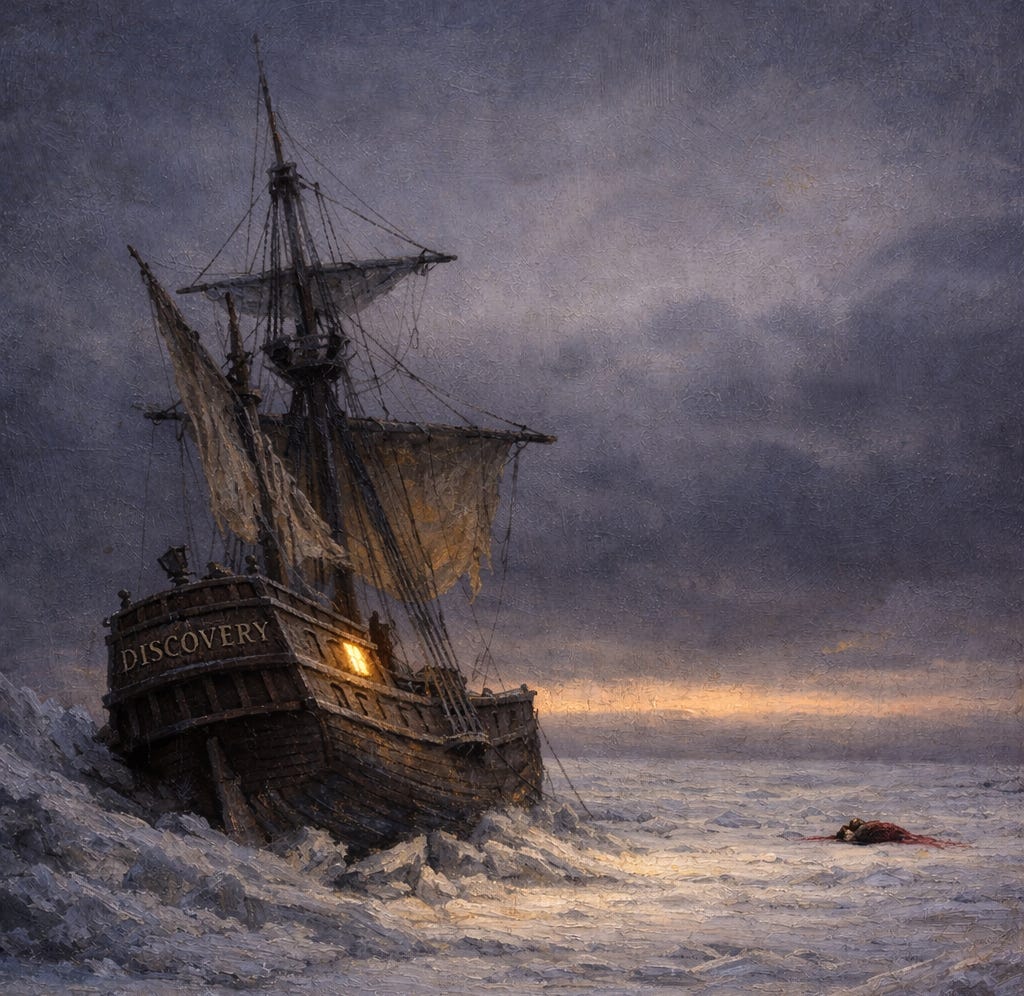
When Henry Hudson was told that John Williams had been found dead in the bush, he finally began to give some thought to just how bad things really were, and how bad they could yet get.
His ship, the Discovery, was aground on the southeastern tip of a frozen bay at the mouth of a frozen river, his crew of twenty-two and he seven months out of London, the Strait of Anian, the Northwest Passage to the exotic spices, perfumes, silks, and precious gems of Cathay and Java, still somewhere beyond the horizon. Instead of sailing the warm, open waters of the Western Sea, they were locked in ice at fifty-one degrees north latitude in the New World, winter’s fury fast-approaching. And now the ship’s gunner was dead.
Hudson looked up from the map he was sketching of the Groneland coast. “You found him?”
“I did, Master,” Henry Greene replied. “Just now. I’d set off early to kill beast or fowl, collect on that reward you’d promised, and not far ashore I found John Williams rigid as an icicle dangling from old man winter’s nose.”
Hudson set down his quill and sighed. “Rouse my son and the surgeon. You will show us your … discovery.”
“Yes, Master.”
“And, Henry, perhaps you should have the surgeon look at those wounds of yours.” Hudson gestured at his friend’s dirtily bandaged fingers.
Greene scoffed, tucked his left hand back behind his back. “‘Tis nothing, Master. Merely nicked myself on those blasted frozen rocks.” He exited the cabin.
Hudson bundled his fur cloak about his shoulders and stared out the frosted panes of the cabin windows. Uneven, unending, ugly yellow-grey ice met his cold gaze. This was surely not the land the ship’s backers, the Company of Gentlemen (including Henry, Prince of Wales himself), had paid Hudson to find. He turned away in disgust.
The four men met on deck: Hudson, his son John, the ship’s surgeon and barber Edward Wilson, and Greene. Hudson didn’t bother telling the men why they’d been awakened so early on such a bitter morn, only gestured with a blackened thumb at the gangplank. Greene led the way.
Hudson didn’t bother telling the men why they’d been awakened so early on such a bitter morn, only gestured with a blackened thumb at the gangplank.
They stumbled across the boulder-jagged beach, across the barren, snow-skiffed land, and into the stunted forest of spindly pine and spruce that grew branches on only their leeward side. Here, the snow lay deeper in spots, and the going was tough, hard, and coarse. Half-buried juniper bushes rasped against their clothing as they advanced. The feeble dawn did little to relieve the minus thirty degree cold. And this was only the middle of November.
“Here lies John Williams,” Greene said at last, pointing at a slight depression in the snow behind some brush.
Williams lay on his face, arms at his side, his instantly recognizable bristly red hair encrusted with ice. His hardships, at least, were over.
Hudson banged his arms together, breath steaming out of his bearded mouth in white clouds. “Examine him. The man was a notorious drunk—obviously, he became intoxicated and wandered away from the shelter of the ship and fainted, dying of exposure to the elements. Who was on watch last night?”
The twenty-four hour ship’s day was divided up into six, four-hour watches, a crew member assigned to each watch. It was his duty to watch over the ship and sound the bell each time that he turned over the half-hour sand glass. It was part of John’s duties to make up the watch list. “Mid-watch: Robert Juet. Morning watch: Adrian—”
“I took that watch, actually, Master,” Greene said. “As I was rising early for hunting anyway, I traded with Mr. Motter. And I can say that I noticed nothing unusual during those eight bells—until I ventured out here at first bell of the forenoon watch, of course.”
Hudson snorted, turning back towards his ship. He was thinking of his map again, of the course to chart to the northwest when the ice finally broke, of the glory that would surely come to him and England when he reached the Orient by a route shorter and safer from taxes and pirates than any yet known. He was a stubborn man and steadfast in purpose.
Wilson shuffled forward in the snow into the depression. He stumbled and toppled over on top of Williams’ frozen body.
“You’ve not been drinking yourself, have you, surgeon?” Greene said.
Wilson glared at Greene. A long, thin teardrop of a man with a wandering left eye, he was as unskilled a surgeon as he was a barber and generally disliked by the men as a result. And the feelings of animosity were mutual, especially where it concerned Greene. The two had exchanged blows over a goose on the western shore of Iceland, each claiming to have shot the fowl.
Wilson rose unsteadily to his feet and brushed himself off. He touched Williams’ neck, clasped Williams’ wrist, and then dropped it. “He’s dead.”
Hudson whirled around. “You bloody sot! We can see he’s dead. What of?”
Wilson eyed the corpse and coughed, spitting out a sizable chunk of phlegm that froze almost instantly. Like most of the crew, he was sick with cold. “I’d say he froze to death, Master.”
Hudson gritted his few remaining teeth. “You and John pick him up and haul him back to the ship. We’ll have a service on board and then bury him in the ground. His belongings will be set before the mast and then auctioned.”
John Hudson groaned. He was a slight boy of seventeen and given no special treatment by his father, the Master. Greene, on the other hand, possessed the broad shoulders of a river bargeman and even greater strength. He was given all kinds of special dispensation by his friend Henry Hudson. John carefully made his way into the hollow with Wilson and Williams and lifted the frozen man’s shoulders while Wilson lifted his legs.
“Oh-oh,” John said.
There was a bloody patch of snow where Williams’ face had been.
“No use stirring up the men until we have some answers,” Hudson said, glancing at Wilson, Greene, and his son.
They were back in his cabin on board the ship, the body of John Williams stored in the hold. The gunner’s face had been battered to a pulp. Wilson had bandaged the man’s head, covering up the wounds before they’d brought him back to the ship. The crew was already nervous about the prospect of wintering further north than any white man had ever wintered in the New World before, and the gunner’s bloodied appearance would have only added to that general feeling of unease.
“But obviously someone beat Mr. Williams to death,” John said, his ferret-like face twitching with excitement. “Or beat him and left him to die in the cold. You’ll have to conduct a full inquiry, father—to catch the culprit.”
“I’d know where to look first, if I were Master,” Greene said.
“And where would that be?”
Greene’s full, red lips blossomed into a cold smile. He used his heavily-ringed fingers to wipe that smile away when he met Hudson’s angry eyes.
“Robert Juet, Master, your former first mate,” he said. “We all saw those tiny footprints around Williams’ body—the ones left visible after our good surgeon had finished blundering about. No man has smaller feet than that evil dwarf Juet. He said there would be manslaughter, someone’s blood would be shed before this voyage was over—back in July, you’ll recall, when we were temporarily trapped by the ice. You saw fit to demote him for his treacherous mutterings, Master, then pardon him. Master Drake would have hung the man from the yardarm for saying such slanderous things and been done with him.”
“You and Mr. Juet have been at one another’s throats for some time,” Hudson said.
“You and Mr. Juet have been at one another’s throats for some time.”
Greene shrugged. “He accused me of cracking his credit and spying on him and the rest of the crew—for you, Master.”
Hudson waved his hand. “Enough of that. Could those footprints not have been made by natives, perhaps?”
“No, father,” John answered. “They had a definite heel and toe, like one of our boots. The natives we encountered on our previous voyage to America wore smooth-soled coverings on their feet—moccasins, they called them.”
Hudson stroked his beard, his face grim as the outdoors. Gusts of arctic wind buffeted the stout-hulled barke and leeched through the planking into the men aboard.
At last, Hudson pointed at Greene. “I want you to find out what you can from the crew. You live amongst them and they trust you—but be tactful.”
He pointed at Wilson. “And I want you to find out anything more you can from an examination of Williams’ body.”
The two men nodded and departed, leaving Hudson and his son alone in the cold, cramped compartment.
John spoke. “We know Robert Juet is guilty of preaching blood and thunder to the men, father, putting many of them in their sick beds with fear of being trapped in the ice forever. But I trust Henry Greene no more than I trust Juet. They’re both villainous men capable of murder.”
Hudson looked at his son. “You’ve sailed on all my voyages in search of a northern passage to the Orient, John. But that does not qualify you to judge men or handle a ship’s crew. Robert Juet has proved himself a first-class navigator over two of those same voyages. And Henry Greene? Well… His singing and flute and fiddle playing are a tonic to the men’s morale—and mine. And both men are needed if we are to survive this winter and sail out of this godforsaken place in the spring.”
“Juet is an old man filled with mean tempers,” John said, “while Green is a roustabout and a gambler—”
“Hold your tongue, boy! Mr. Greene was a guest in our home not so very long ago. I will hear nothing bad about the man.”
“How true,” John said, before slinking out of the cabin under a withering glare.
Hudson sat down at his desk, running a gnarled hand over his grey, weather-lined face. What an ill-fated voyage this had been so far. First, the ship’s cat had gone mad when they’d rounded the Orkneys, racing from side to side and staring overboard and yowling like the devil—a sure sign of bad tidings. And then Mount Hekla had erupted as they’d passed it by on the coast of Iceland—a sure sign of foul weather in short time. And the bad weather and bad tidings had indeed come, fog setting in and gale-force east winds driving the icebergs together into a hard pack that could not be penetrated. They were forced to anchor the ship for two weeks in Lousy Bay. And only a short time after finally setting sail again, they’d become caught up in ice far from the sight of land, and a mutiny had almost broken out.
Order had just barely been restored by reasoning with the men. Congratulating them on journeying farther into the Northwest seas than any Englishmen had before. Convincing them to continue the search for the passage that would make them all a part of history. But after successfully navigating the conflicting currents of the Furious Overfall, dodging treacherous ice every league of the way, and finally sailing into a large body of water that promised to be the Western Sea, months of fruitless sailing had proved it to be nothing more than a bay, not an ocean passage at all.
Hudson slammed his fist down on his desk and uttered an oath. He was fast becoming an old man, and still the riches of the East lay well beyond his bowsprit.
Greene reported back later that afternoon, as the weak sun was being swallowed by the icy horizon. Hudson was on the quarterdeck, watching his men carry tools and timber from the ship’s hold to the leveled clearing in the bush where their winter house would be built. The sailors were stumbling all over each other, hearty seamen used to dancing across rolling decks and scampering up and down singing rigging, not trudging about on frozen, snowy ground with house-building equipment on their shoulders. Hudson shared their discomfort, for on land, a ship’s Master was not such a sure and big man, either.
“What have you learned, Henry?” he asked Greene.
“Quite a lot, Master,” the man replied, his handsome face alive. “John Williams is remembered as being on-deck and working almost to midnight last night, before retiring below-decks.” Greene glanced around. “And there he was heard in rather heated conversation with one Mr. Juet, in the gunroom.”
“What was the nature of their conversation?”
“Well, Master,” Greene leaned closer to Hudson in the gathering gloom, “they were discussing … mutiny—a topic not unfamiliar to Mr. Juet. He was putting forth the proposition that you, Master, had wasted precious summer sailing weather by meandering about in this bay, that you’d lost your bearings, as it were, that we’d never escape this frozen Hell and return to England with you at the helm.”
“They were discussing mutiny.”
Hudson grunted and wiped his red, running nose. “What was Mr. Williams’ reply?”
“Aye, Master, that’s just it. Williams was having none of it. Juet was trying to get the man onside, no doubt, so he would have ready access to the shot and powder, the muskets and cutlasses in the gunroom, the weapons he and his gang would need to seize control of the ship. But Williams was most adamantly opposed and threatened to report Juet to the mate. They left it there, so far as my witness tells me. But Juet stood watch the first part of last night, as you know, and he could have easily roused Mr. Williams, cooled the man off but permanent so he wouldn’t upset his traitorous plans.”
“Robert Bylot!” Hudson said.
The recently-appointed mate came scrambling up onto the quarterdeck. “Yes, Master?”
“You and the bos’n seize Robert Juet and place him in irons.”
Bylot looked uncertain, but Hudson’s uncompromising face soon sent him scurrying off to fulfill the order.
Greene leaned closer still, whispering familiarly in Hudson’s frostbitten ear. “I should like to have Williams’ wool coat, Master, if it’s at all possible, as I am so very cold in this weather with no proper garment to clothe me. I know it be tradition to auction—”
“It’s yours.”
The surgeon reported back later that evening. Hudson was in his cabin with Greene, helping the man practice writing by having him recopy log entries. Wilson observed the chummy pair, a frown creasing his ragged lips. The passenger’s familiarity with the Master, which oftentimes included dining with Hudson to the exclusion of the other ship’s officers, had long been a source of bitterment with Wilson.
“Begging your pardon, Master,” he said, stifling a burp in Greene’s general direction.
“Yes, what is it?”
“My examination of the dead man is complete.”
Hudson waited, then rasped, “And what are the results?”
“Well, Williams’ facial and head wounds lead me to believe, as a surgeon and barber of some two years good—”
“Get on with it!”
“Well, given the severity of the blows, the broken nose and smashed eye sockets and dislocated jaw, I would say almost certainly that Williams was most probably beaten to death by someone. That is to say, Master, he was likely murdered.”
Hudson groaned. “We know he was murdered, you fool! We already have the murderer locked up.”
“Oh, well, just confirming the facts, then.” Wilson burped again. “I, uh, found splinters in the dead man’s skin, Master,” he said, covering up his mouth, “which would indicate that he was most likely struck with a wooden club of some sort, as opposed to, say, a man’s fists, or a metal bludgeon of some sort.”
“What do you make of that, Henry?” Hudson asked.
Greene winked. “I’d say this man’s got scurvy, Master, and a bad case at that. You best drink some boiled tamarack bud, surgeon, take a taste of your own decoction.”
Hudson frowned. “No. I meant—”
“All of the timber was locked tight and dry in the hold till today, Master,” Greene said, scratching his chin. “But there’s driftwood about, I suppose, if you dig deep enough. And…”
“Yes?” Hudson asked.
“There’s the bos’n’s club, Master—three knocks on the head for cursing and all that. Mr. Juet could certainly get his hands on that and know how to use it.”
“Yes,” Hudson agreed. He dismissed the surgeon. Then he dismissed the whole distasteful subject from his mind. “What say you play your flute for me tonight, Henry?” he asked, clapping his friend on the shoulder.
“Uh, perhaps the fiddle, Master?”
“Just so.”
For most of the night, the north wind whistled through the rigging, hurtled ice pellets rattling against the ship’s sides, clawing cold into the vessel and the hearts of her shivering crew. But in the depths of early morning, the wind died down, and the clouds broke, and the dancing Northern Lights paintbrushed the pitch-black sky in brilliant hues of green and red and blue, dazzling the man on watch and setting the timber wolves to howling.
Hudson awoke at bitter dawn. The clear skies meant a further drop in temperature, but he stood out of bed with the resolve of the deep-water Arctic mariner, the ice-water in his veins bracing him against the brutal weather. Today was an important day, for today construction on the house—the building that would be the crew’s home during the long, dark, cold winter ahead—was to begin.
Hudson and the ship’s carpenter, Philip Staffe, had quarreled violently only days before about the house. Staffe had claimed that the order for construction had been left too late, that it was now too cold to build anything. Hudson had dismissed that as nonsense. Then Staffe had insisted that he was a ship’s carpenter, not a house carpenter, and would not, therefore, assist in the construction. Hudson had struck Staffe, threatened to hang the man, and there had been ill feeling between the two. Eventually, however, the carpenter had agreed to build the house.
Hudson cleared ice away from the window of his cabin with a dampened hand and looked outside. His eyes widened when he spotted two men armed with muskets striding into the forest on the starboard side of the ship. It was his friend Henry Greene and his enemy Philip Staffe, and Hudson bristled with rage.
Not even bothering to don his cloak, he rushed out of his cabin and up onto the deck. “Get back here you two!”
But the men were already disappearing into the forest hundreds of yards beyond, and a flock of geese honking loudly overhead served to drown out Hudson’s command. He balled his hands and gritted his teeth. Staffe was desperately needed in the house construction, and here he was gallivanting off for a day’s hunting. And Greene! How could his supposed friend, who Hudson was paying out of his own pocket since he was not on the company books, take up with a man Hudson had so recently fought with?
“Bloody traitor. Bylot!”
“Bloody traitor.”
Bylot stumbled out onto the deck. All was brittle and icy cold, and it took his breath away.
“You want John Williams’ coat?”
“I—”
“It’s yours.”
Bylot made for the mainmast, dug the coat out of the pile of clothing there, and flung it on his shoulders.
“Morning, father,” John said, sidling up to Hudson’s elbow. “I see you’ve changed your mind about who gets the coat.”
“I will not provide comfort to those who consort with my enemies,” Hudson replied tersely. “Mr. Greene has betrayed me.”
“As I warned you he would, father.”
Before Hudson could say anything, John added, “Why not search his cabin, as well, while he’s away? I hear he’s been hoarding food against your orders.”
Hudson yelled at the mate, who was cavorting on the hatch in his new coat. “Bylot! You and John will search Mr. Greene’s cabin—immediately. Be on the lookout for food or anything else the ungrateful thief shouldn’t have.”
After a cold, angry breakfast of salt pork and hard biscuit, Hudson made his way down into the ship’s hold, William Wilson, great, profane bear of a bos’n accompanying him.
Robert Juet was huddled in a corner. He glanced up as the men approached. “Morning, Master,” he said, a sour smile on his wrinkled monkey-face. Then he sniffed the chill air and added cheekily, “Is that the Spice Islands I be smelling this morning?”
Hudson bristled. The little, old man had always been a cynical, insolent cur, and a demotion and imprisonment were not about to reform his character. “Why did you kill Mr. Williams?”
“Did I?”
“Who did, then?”
“Not me.”
Hudson rubbed his nose, tugged on his beard. “You stood watch when Williams was most likely killed. Did you see or hear nothing?”
Juet stared down at his chained feet. “Well… the truth is… I was asleep most of my watch.”
“Malingerer!”
Juet glanced up, the wrinkles on his face creasing into a mock-hurt expression. “I was keeping good watch, Master, over the ice and snow—the frozen treasures of the Orient. But I got tired with the eyestrain of looking at all those precious gems and just set my head down in the galley for a moment.”
“More like you got bloody tired of heating the bloody sandglass to make ‘er run faster,” Wilson said, pawing his nose.
Juet glared at the giant. “I didn’t kill Williams.”
“Your bootprints were found in the area of Mr. Williams’ body.”
“What bootprints?!”
Hudson shook his head. “Do you deny discussing mutiny with Mr. Williams earlier in the evening?”
“With Williams? Yes.”
“Mr. Greene says—“
“Aye, Mr. Greene,” Juet rattled the chains that bound him.
Bylot and John Hudson found their Master at the helm, staring out at the endless expanse of ice and snow on the bay, his beard made whiter still by the frost.
“Look what we found in Greene’s cabin, father,” John said, running to his side, holding out Greene’s heavy, wooden flute. He showed his father the chips and cracks in the boxwood instrument. “It was hidden away in his chest, wrapped in a blanket. It would make a mighty fine weapon, I think.” He swung it like a club.
“He would not play it for me last night,” Hudson said.
John blew on the instrument, and the sound was anything but sweet.
“What else did you find?”
“This, Master,” Bylot spoke up. He opened the hefty sack he’d been holding and dumped its contents out onto a pile of rope. Salt pork and cod, dried peas and cheese, and biscuit poured out, many days’ rations.
John said, “Williams was known to have hoarded his rations, too, yet no food was found amongst his belongings.”
“Mr. Bylot,” Hudson said, “when Mr. Greene returns from his hunting party, have two sturdy men seize him and place him in irons—with Mr. Juet.”
When he spotted Robert Bylot wearing the warm winter coat he’d been promised, Henry Greene came aboard the ship just as sunset was setting off the ice crystals in the late-afternoon air and grappled with the mate. But William Wilson and Arnold Ludlow quickly grabbed him, thrust him kicking and screaming into the hold, and locked the hatch above him.
Bylot straightened out his new coat and thrust his hands into its pockets to get them in order. Then he pulled his right hand out, clutching a slip of paper. “Look here, Master.”
Hudson took the piece of paper and unfolded it.
“I, Henry Greene, of London, do hereby agree that I owe John Williams, of Ipswich, the sum of twenty pounds, that amount being a gambling debt to be repaid in full no more than one year from the date of this note.” The note was signed, “Henry Greene,” dated “December 1, 1609,” almost exactly one year earlier.
“What is it, Master?”
Hudson stroked the frozen tendrils of his beard. “Evidence.”
“I’ll bet that we have no further trouble this voyage,” John said early the next morning.
Father and son were at the house site, watching the crew fumble with tools and nails, their fingers almost too numb to grasp them. “Greene and Juet are villainous men, I’ve always said so. Juet plotting against you, Greene using you, consorting with your enemies. It’s good that they’re both locked—”
John’s mouth fell open, but no more words issued forth. He was staring at Robert Juet and Henry Greene as they approached the clearing in the bush, free and unencumbered.
“They seem to have made up their differences after spending some time together,” Hudson stated with satisfaction, observing the two men in casual conversation. They saluted and grinned as they walked by. “Good. Their help is needed in building the house.”
“The help of murderers and thieves?!” John asked.
Hudson grunted and shook his head. “You overplayed your hand, son. That note you wrote—about Greene owing Williams twenty pounds—and placed in the pocket of Williams’ coat, was your undoing.” Hudson gestured disdainfully with his mittened hand. “You see, Greene is illiterate, like most of this rabble.”
“But… But I saw him writing the log—in your cabin, father.”
Hudson snorted. “He was merely copying what I had written first. I was trying to teach the man the rudiments of reading and writing, helping him as I have so often helped him. But he is a poor student, I’m afraid. And a worse friend.” Hudson looked at his son. “You did a good job of copying his chicken scratch. When did you do it?”
John sighed and hung his head. “I spent yesterday afternoon working on it. Put it in the pocket of Williams’, er, Bylot’s coat just before Greene came back from hunting.”
“I suspected so, and now you have confirmed it. The other culprit could have been Edward Wilson, for he knew about the investigation we were conducting, as well, and is literate, and loathes Greene as much as you do.”
John looked up. “I was only providing motive. But what about Greene’s broken flute? Is that not the murder weapon?”
“Remember, one room for the officers and one for the men!” Hudson yelled at his harried carpenter.
Staffe twisted his head around and nodded, then turned back and cursed.
Hudson looked again at his son. “When I realized someone had deliberately put the note in Williams’ coat to further implicate Greene in his death, I began to wonder if there wasn’t more trickery at play in the whole affair. So, I confronted Mr. Greene with his broken flute and the extra food, and he told me the real story of his finding Williams in the bush.
“He told me the real story of his finding Williams in the bush.”
“He’d remembered the heated words Juet and Williams had exchanged the previous evening, for he’d heard them himself, and he sought to put it to advantage, to implicate his enemy in Williams’ death. He retrieved his flute, therefore, not wanting to rouse anyone with a musket shot and having no other weapon at hand, and Juet’s boots. Then he battered Williams’ face with the musical instrument and made bootprints in the snow to make it appear that the man had died violently and deliberately, at Juet’s hand. But Williams was already well-frozen, so he had to cut his own fingers to provide the blood that was necessary at the scene.”
“And—and… you believe him?”
“It makes sense—he has no reason to lie, for it clears Juet of the crime.”
“And himself!”
Hudson winced as a gust of wind sent snow spraying into his face. “He admits stealing Williams’ food—like he tried to steal his coat—but there never was any murder, son. Williams was a sick man to begin with, and he got himself drunk on grog and wine and wandered off and fell asleep in the snow and froze to death, as I suspected originally.” Hudson slapped his mitts together and spat on the ground, clearing his palate and mind of the whole unsavory affair.
“Both men have promised to be loyal and faithful and well-behaved for the rest of our voyage. And they will be needed to help sail the ship when the ice breaks.” The heavy lines on the Master’s face lifted momentarily. “When we sail for the Northwest—” He stopped when he noticed the dirty look from Philip Staffe. “For England in the springtime.”
John stared down at the snow, thin shoulders hunched in defeat and frustration. “I still say Juet and Greene are villainous men and should be locked up for your own protection.”
But Hudson was no longer listening. He was gazing out to the bay, his mind drifting off to the warm, open waters of the Western Sea, where sea salt and exotic spices assailed his nostrils, where riches untold awaited him. He would yet find the Strait of Anian, he was confident, come springtime.
Come springtime, when the ice finally broke and the Discovery once again set sail, Robert Juet and Henry Greene led a mutiny that resulted in Henry Hudson, his son, and seven other crew members being thrown into a small boat and set adrift on the bay, never to be heard from again.
Looking for More Stories?
Read Nikita’s fiction here.
Or catch up on these stories from Curated by Costiuc:


Personal Updates
Where You’ll Find Nikita
📝 “Drop In and Write” Writing Group
Giving feedback, sharing my own work, and participating in great conversations
Every Thursday, 5:30–7:00 PM
Free admission
🍽️ Feast Kitchen – Volunteering
Helping immigrant chefs serve delicious food
• Wednesday, March 11th, 4:00–8:00 PM
Menu items range from $15–$25
This Month’s Snapshot

Daria and I have exciting news. We’re moving to Phoenix. We’ll miss Spokane, but we’re very excited for this new chapter.
Pupdate
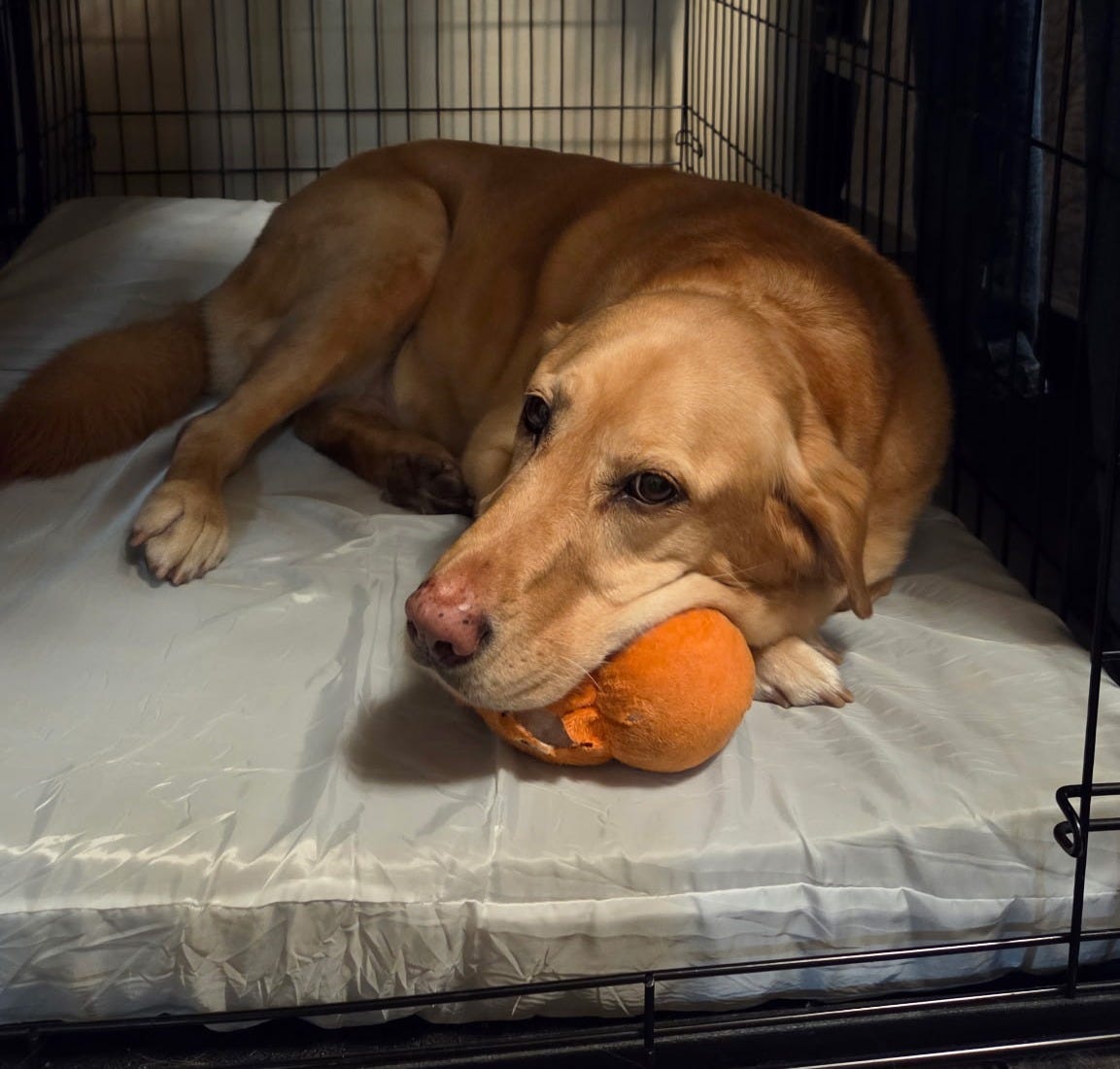
Arya prioritizes maintaining a work-life balance.
Next Month on Curated by Costiuc
At 30,000 feet, a psychologist diagnoses a killer.
Curated by Costiuc is a monthly newsletter featuring curated mystery, thriller, and suspense stories. “Ice Sailor” is copyrighted © 2006 by Laird Long and is reprinted here with the author’s permission.