

Not Work. Not Murder. Just a $500,000 Problem.
A man in rags tackles an impossible case.

Table of Contents
Introduction
Featured Story
Personal Updates
Next Month’s Story
Introduction
Story:
$500,000 Reward
Author:
Melville Davisson Post
Genre:
Hardboiled
Note from Nikita:
How often do we get bamboozled by first impressions? More than we’d like.
In today’s story, a law enforcement agent meets a homeless person and assumes he’s dealing with a harmless nobody. Then the homeless man opens his mouth and, well, let’s just say the agent learns something.
First impressions don’t just lie about people. They lie about places, too. This Thanksgiving, Daria and I went to a $100 buffet. The spread looked gorgeous, but we would’ve been better off at Denny’s: tastier food for a tenth of the price.
If you’ve ever been fooled by a first impression—a place, a person, or a “deal”—I want the story. Hit reply or leave a comment.
But for now, enjoy “$500,000 Reward” by Melville Davisson Post.
$500,000 Reward
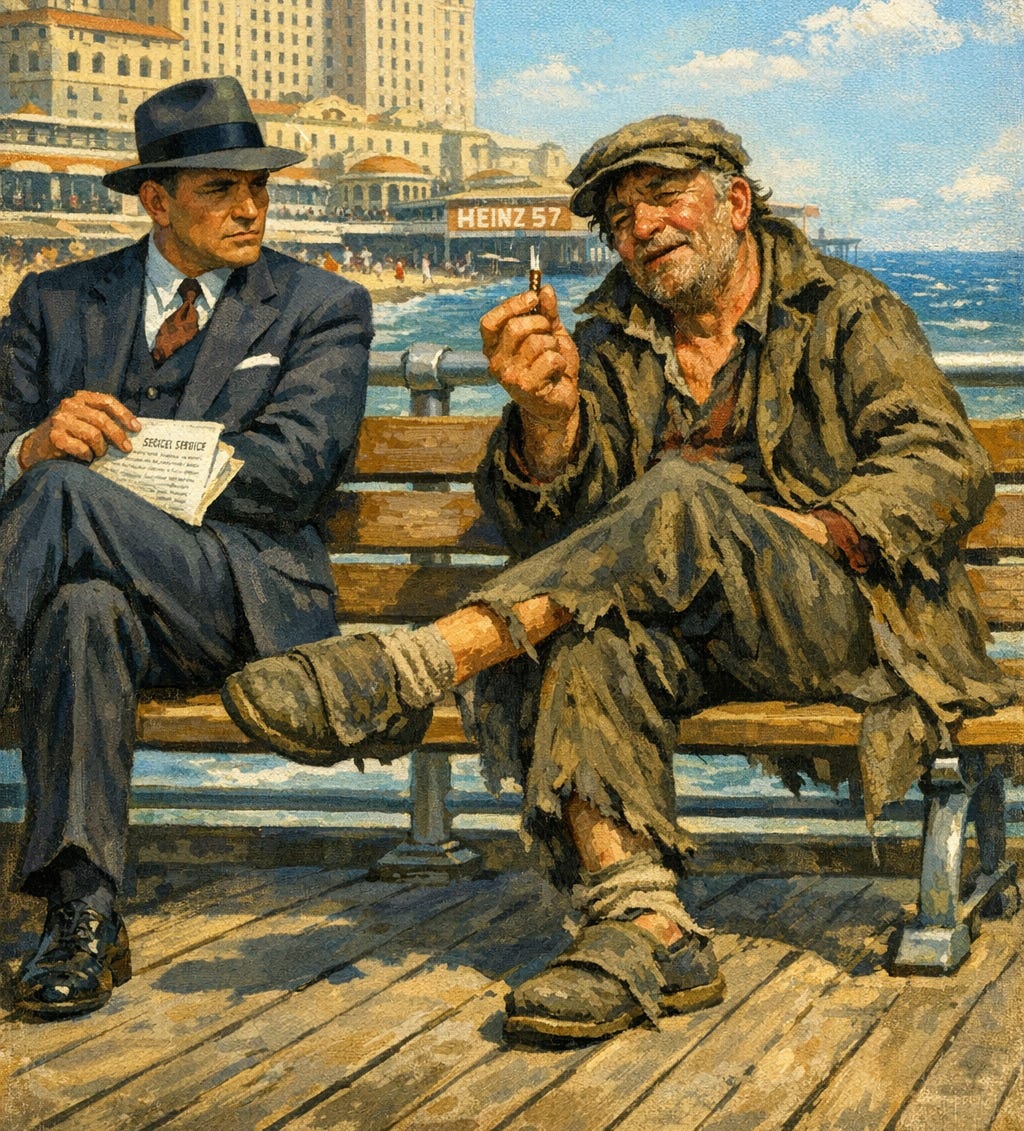
You ask if anything remarkable ever happened to me in the course of my cases. You probably mean to ask if I was ever kissed on a deserted street by a mysterious woman with a beautiful face. Or if I ever encountered a priest in red robes, pale as alabaster, who pieced together the key evidence of a baffling crime with such uncanny insight that I stood astonished at his sharp perception?
No, nothing like that ever happened to me. But I’ll tell you what I did find. I met a drunken vagrant in Atlantic City who was the best detective I ever saw. Now the boys in the department think highly of me. I’d rather they didn’t know how a drifter fooled me in Atlantic City. But since we’re stuck in this airport for another two hours and you seem like a thoughtful sort, I don’t mind telling you, so long as you promise never to breathe a word of this to anyone.
I was sitting out on the Boardwalk in front of the Traymore Hotel. I was completely worn out, and I had gone to Atlantic City for a day or two to breathe the sea air. The truth is, the whole department was down and out. You may remember what we were up against. It eventually made the newspapers: the Treasury bond plates had gone missing. We knew how they’d been taken, and we believed we knew the man at the head of the thing. Too big a heist for a petty criminal—this was a Mulehaus job. With those government plates, he could print bonds just like the Treasury’s. And flood the world with them.
You see, these bonds are spread all over the country. They’re owned by people from every walk of life. It’s not like it used to be, a banker’s affair we could track down and contain. There was no way to gather up all the bondholders. A major crook like Mulehaus could slip a hundred million of those bonds into the country without causing the slightest stir.
I’ll say this for Mulehaus: he’s the hardest man to identify in the entire world of criminals. Scotland Yard, the Sûreté—everyone says so. I don’t mean cheap, storybook disguises, like fake beards or a fake limp. I mean his ability to truly become the person he pretends to be. That’s why no one could keep track of Mulehaus, especially in the cities of South America. He was a French banker in Egypt and a Swiss banker in Argentina.
The job with the government plates he ran was flawless. We didn’t have a single lead. Naturally, we assumed they’d head for Mexico or some South American country to start printing there, so we had the border tightly sealed. Nothing could have gotten out across. All the customs officers were cooperating with us, along with every agent of the Department of Justice. You see, the government had to recover those plates before the criminal started printing or else recall every bond of that series across the entire country. It was a nightmare of a situation.
Of course, we had combed through the records of all the major criminals to see whose style this sort of job was. And the thing narrowed down to either Mulehaus or old Vronsky. It wasn’t Vronsky, he was locked up. It had to be Mulehaus. But we couldn’t track him down. We didn’t even know if Mulehaus was in America. This crook had a genius for choosing the right men to work for him: he might have been running the operation from Rio or some Mexican port for all we knew. But we were certain it was Mulehaus’s job. He sold the French securities in Egypt back in ’51, and he’s the one who flooded our market with fake Argentine bonds—you can find that case in the Federal Reporter.
Anyways, I was sitting out there, watching the sunlight on the sea and thinking about the case, when I noticed the vagrant who I mentioned earlier. I hadn’t really looked at him before. He had moved around from behind me and was now leaning against the galvanized pipe railing. He was a large, heavyset man, slightly stooped, unshaven, and dirty. He was barely dressed: a cap likely pulled from a trash bin, a tattered coat, and carpet slippers wrapped around his ankles to hide the fact that he wasn’t wearing socks.
As I watched him, he darted forward, picked up a cigarette butt someone had tossed aside, and returned to the railing to smoke it, his mouth slack and loose, his nose shifting like a piece of rubber. All in all, this vagrant was the most hopeless human wreck I had ever seen. I suppose an impulse to offer the man some sort of clothing prompted me to speak to him.
“You’re nearly naked,” I said.
He crossed one leg over the other, the toe of his carpet slipper just touching the ground, like a burlesque performer, and took the cigarette out of his mouth with a small flourish.
“Sure, boss, I’m not dressed up. But if I had a few bucks, I could surprise you. Any chance you could point me to some?”
He stopped my reply with a small flourish of his fingers holding the cigarette butt.
“Not work,” he said, dipping his head slightly, “and not murder. Anything you like in between.”
“Not work and not murder. Anything you like in between.”
There was a kind of cocky indifference about the man that gave his wretched condition a sort of shabby dignity.
“All right,” I said. “Go out and find me a man who deserted from the German Army, worked as a tanner in Basel, and started his life as a sailor, and I’ll give you $100.”
The man let out a low whistle, two sharp notes.
“Some order,” he said. Then, pulling a toothpick from his pocket, he stuck it into the cigarette butt, which had become too short to hold between his fingers.
At that moment, a boy from the post office brought me the daily report from Washington. I got out of the chair, said goodbye to the man, and went into the hotel. There was nothing new from the department except confirmation that our network across the country was in close contact. We had offered a $500,000 reward for the recovery of the plates, and the Post Office was now posting the notice across America. I had forgotten all about the vagrant when, around five o’clock, he passed me a little way down from the Steel Pier.
He was striding quickly and clutched something tightly in his hand. “Found him, Boss. See you later.”
“See me now,” I said. “What’s the rush?”
He opened his hand quickly, revealing a silver dollar pressed against his palm with his thumb.
“Can’t stop. Going to get drunk. See you later.”
I smiled at the sly creature. He was saving me for when he sobered up. He could claim to point out Mulehaus in any passing chair, and I’d give him a dollar just to be rid of his nonsense.
He was waiting for me when I came out of the hotel the next morning.
“Morning, Boss. Found your man.”
I was curious to see how he would frame his story. “How did you find him?”
He grinned, his lip and loose nose twitching.
“Some luck, Boss, and some detective work. Here’s how it went: I figured you were pulling my leg. But I told myself I’d keep an eye out—maybe you were serious. Anything can happen.”
He lifted his hand as if to hook his thumb into the armhole of a vest, then remembered he was wearing only a buttoned coat and let it fall.
“Believe it or not, Boss, this is the God’s honest truth. Around four o’clock, up near the Inlet, I passed a big, well-dressed, banker-looking gentleman. He walked stiffly and swung his leg forward.
I wheeled over to him.
‘Rough morning, Admiral?’ I said.
He looked at me sort of strange. ‘What makes you think I’m an admiral?’
‘Well,’ I said, leaning on one foot, thoughtful-like, ‘nobody could be looking at the sea with that loving look unless he’d bossed her a bit.’
He laughed. ‘Not an admiral, but it’s true I’ve spent my life at sea.’”
The hobo paused and held up his first and second fingers in a V.
“Two points, Boss—the man had been a sailor and a soldier. Now, how about the tanner part?”
He scratched his head, moving the ridiculous cap.
“That part puzzled me, so I crept along toward the Inlet thinking about it. If a man had been a tanner, especially a foreign, hands-on tanner, what kind of marks would he have? I tried to remember everyone I’d ever seen handling a hide, and suddenly I recalled that the first thing a shoemaker does when he picks up a piece of leather is smooth it out with his thumbs. And I said to myself, now that’s what a tanner does too, only he’d do it all the time. Then I asked myself, what marks would that leave?”
The hobo paused, mouth open, head tilted to one side. Then he straightened, like a spring released.
“And right away, Boss, I got it: flat thumbs.”
He stepped back triumphantly and raised his hand.
“And he had them. I asked him what time it was, but the real reason was so I could see his hands.”
It was clever, but the question had to be asked. “Where is this man now?”
The hobo shuffled awkwardly, his fingers nervously picking at his coat pockets.
“That’s the trouble, Boss,” he said. “I meant to follow him for you, but he gave me a silver dollar and I got drunk… you saw me.”
His story was interesting, so I offered him $10. Then I got a surprise.
The hobo looked at the bill in my hand and stepped toward it but clenched his teeth and stopped himself.
“No, Boss,” he said, “I’m in it for the hundred. Where’ll I find you around noon?”
I promised to be on the Boardwalk in front of Heinz’s Pier at two o’clock, and he turned to shuffle away.
I called after him. You see, there were two curious details in his story: how did he get a dollar tip, and why had he described his imaginary man as banker-looking? Mulehaus had appeared banker-like in both the Egypt and Argentine schemes. I set the second question aside for the moment, but I asked about the dollar, and he came back immediately.
“I forgot about that, Boss,” he said. “Here’s how it happened: the admiral kept staring out at the sea, where an old freighter was heading south (you know those fruit ships—one of them goes by every day or two). Then he asked for a favor.
‘Cut across to the hole in that old board fence and see if an automobile’s been there, and I’ll give you a dollar.’
And I did it, and I got it. Be there on time, Boss, and I’ll lead him to you.”
He shuffled away.
That gave me a new insight into the man. He was a sharper operator than I had imagined. I wasn’t going to get away with just giving him a tip. He was going to some trouble to squeeze a full hundred-dollar bill out of me. I couldn’t explain how he’d hit Mulehaus’s description in his made-up story, but I believed I knew what the man was up to.
He was a sharper operator than I had imagined.
I was sitting on a bench at the entrance to Heinz’s Pier, smoking a cigar, when the hobo shuffled up. He came down one of the side streets from Pacific Avenue. I was not in a very good mood. Everything I had sent after Mulehaus was treading water: agents along the Canadian and Mexican borders, agents at the customs offices, and even agents on every ship and plane leaving America, watching for anything suspicious taken aboard en route. We had the entire country sealed up as tight as a drum, but that was small comfort when the Treasury was raising hell over the missing plates, and we still didn’t have a single lead. I felt an absolute fool for giving this filthy vagrant another chance to bother me.
He shuffled up to me in an apologetic, conspiratorial manner. “Boss, you won’t get mad if I say something?”
“Say it.”
The expression on his dirty, unshaven face became, if possible, even more foolish.
“Well then, Boss, begging your pardon, you’re the Chief of the United States Secret Service from Washington.”
That made me furious—both at the man’s boldness and at my own unforgivable carelessness in allowing the official report delivered to me the previous day by the post office messenger to be visible to this man. I took the cigar out of my mouth. I could barely keep from hitting him.
“And I’ll say a little something myself,” I said. “When you sobered up this morning and remembered who I was, you went by the post office to confirm it. And while you were there, you saw the notice about the reward for the stolen bond plates. That gave you the idea you used to patch together your little fairy tale about how you got the dollar tip. Once you figured out my identity—thanks to my own damned carelessness—and saw the posted reward notice, you expanded your little scheme. That’s why you refused the $10.”
I spat. “If you had just planned to squeeze a ten out of me, it would have worked. But now you won’t get a single damned cent from me for finding that fake tanner. There’s no such person.”
I intended to shut him down completely, but his reaction was even more surprising than I expected. His jaw dropped, and he stared at me in astonishment.
“No such person? Why, Boss, I swear before God, I found a man like that, and he was a banker, one of the big ones, as sure as there’s a hell.”
There it was again, the description of Mulehaus. And it completely baffled me. Every other turn of the hobo’s thinking about this case had been perfectly clear. I could see his intention behind every move and exactly where he had gotten the material for each detail of his story. But this unmistakable, specific description of Mulehaus was beyond my understanding. Everyone, of course, knew we were searching for the missing plates—the Treasury’s reward made that public knowledge. But no one outside the trusted agents of the department knew we were after Mulehaus himself.
The vagrant shuffled a step closer to the bench where I sat. The worry on his big, slack face was unmistakably genuine.
“I can’t find the banker, Boss. He’s vanished. But I believe I can find what he hid.”
“Well,” I said, “then find it.”
The hobo threw out his limp hands in a whimpering gesture. “Now, Boss, what good would it do me to find those plates?”
“You’d get $500,000,” I said.
“I’d get thrown into a cell by the first cop who laid hands on me. That’s what I’d get.”
The man’s dirty, unshaven jowls began to tremble.
“I’ve got a lead on this, Boss, as sure as there’s a hell. That banker was scouting the area. I’ve thought it all through, and here’s how it must be: they’re afraid of the border and of customs, so they’re hiding the loot somewhere near and planning to get it out on one of those fruit steamers on their way to Tampico. They’d most likely have those plates bundled up in a sailor’s chest.”
He scratched his rubbery nose.
“Now, Boss, you’d probably ask why they haven’t done it already. And I’d answer that there hasn’t been a ship along since the banker asked me to check. I’ve been especially careful to find that out.”
Then the man began to whine. “Have a heart, Boss. Come with me. Give me a chance.”
It wasn’t the man’s pleading that moved me—I’m a bit too old to be so soft-hearted—nor his supposed deductions. It was that “banker” detail, sticking like a burr in the hobo’s story. I wanted to keep him cooperative until I understood where he’d gotten that detail. It no doubt seems like a small reason to go with him, but you must remember that in our line of work, small details are often big signboards.
We went straight from the end of the Boardwalk to the old shed. It was open, its door hanging loose on a pair of leather hinges. The shed was small, about twenty feet by eleven, with a hard dirt floor packed down by the workers who had used it, a mix of clay and sand. All around it, from the sea to the board fence, was soft sand. A few pieces of old junk were scattered around the shed, but there was nothing of value there or the place would have been locked up.
The hobo started right in with his deductions. He pointed at a single set of footprints clearly outlined in the soft sand, leading from the board fence to the shed and back again.
“Now, Boss, see these footprints. No other tracks are anywhere near. The man that made those tracks carried something into this shed, left it here, and it was something heavy.”
I was fairly certain the vagrant had made the tracks himself, but I decided to play along. “How do you know that?”
“Well, Boss,” he said, “take a look. In the tracks coming to the shed, the man was walking with his feet wide apart. In the ones going back, he was walking with his feet one in front of the other. That’s because he was carrying something heavy when he came and nothing when he left.”
This observation about footprints had never occurred to me.
The hobo continued. “You ever notice a man carrying a heavy load? He kind of totters, walking with his feet spread apart to keep his balance. That makes his footprints go side by side, instead of one in front of the other like when he’s walking light.”
It’s the truth. I’ve confirmed it a thousand times since that hobo first pointed it out to me. A line drawn through the center of the heel prints of a man carrying a heavy load will form a zigzag, while the same man’s prints without the load will form an almost straight line.
The vagrant concluded with his deductions. “If it came in and didn’t go out, it’s still here.”
Then he began searching the inside of the shed. He examined it like a man searching a box for a jewel. He moved the pieces of old scrap and literally felt over the entire shed from one end to the other. He would have found a bird’s egg if there had been one. Finally, he stopped and stood with his hand spread across his mouth. And I chose this critical moment to light the fuse under his little game.
“Suppose,” I said, “that this man with the heavy load wanted to mislead us. Suppose that instead of bringing something here, he carried one of these old castings away?”
The hobo looked at me without moving a muscle. “How could he, Boss?”
“By walking backward,” I said.
It had occurred to me that the hobo might have staged this evidence, and I wanted to test that theory.
The test produced more reaction than I expected. The hobo darted out through the door. I followed, expecting to see him run off, but he wasn’t fleeing. He was crouched down over the footprints, and a moment later, he rocked back on his heels with a small, triumphant yelp.
“Wrong, Boss,” he said. “He was definitely coming this way. If a man’s walking forward in sand, mud, or snow, the toe of his shoe flicks a bit of it outward. If he’s walking backward, it’s the heel that does it.”
At this point, I felt some respect for the man’s abilities. He got up and returned to the shed. There he stood again, in his usual stance, fingers over his mouth, looking around the empty space—a place where, as I’ve said, you couldn’t have hidden even a bird’s egg.
I watched him without saying a word, because my interest in the situation had now been fully stirred, and I was curious to see what he would do. He stood still for about a minute, then snapped his fingers.
“I’ve got it, Boss. Give me a dollar so I can get a bucket.”
I gave him the money since I was now deeply puzzled, and he went out. He was gone for perhaps twenty minutes, and when he returned, he was carrying a bucket of water. But he had clearly been thinking while he was gone, because he set the bucket down carefully, wiped his hands on his trousers, and spoke with a faint, apologetic whimper.
“Now look here, Boss. Do I get the $500,000 if I find the stuff?”
“Do I get the $500,000 if I find the stuff?”
“Of course.”
“And there won’t be any tricks, Boss? You’ll take me to a bank yourself and put the money right into my hand?”
“I promise you.”
But he was still uneasy about it. He shifted from one foot to the other, and his soft, rubbery nose twitched.
“Now Boss, I’m still worried about tricks. I don’t want any strings attached. If I get the money, I want to go and blow it. I don’t want you handing me the cash and then trying some reform stunt—holding it in trust, sending a probation officer after me, or pulling any funny business. I want the money and a clear road to the bright lights, with no one tipping off the cops. Do I get that?”
“It’s a deal.”
“Okay,” he said.
He picked up the bucket. Starting at the door, he carefully poured the water over the hard-packed earth. When the bucket was empty, he brought another, and then another. Finally, about halfway across the floor, he stopped.
“Here it is!”
I was walking beside him, but I saw nothing to justify what he said.
“Why do you think the plates are buried here?”
“Look at the air bubbles coming up, Boss.”
It was something I hadn’t known until that moment, but it’s true: if hard-packed earth is dug up and then repacked, air gets trapped inside, and when you pour water over that spot, air bubbles will rise to the surface.
Did I find the plates there?
Yes, hidden in the false bottom of an old steamer trunk.
Did the hobo get the money?
Certainly. I placed a briefcase with the notes directly into his hand and let him walk away as I promised.
Then why did I begin this story by saying the hobo faked me? After all, he found the plates and was entitled to the reward.
I didn’t see the fake either, until I got this letter, neatly written and postmarked from Buenos Aires.
“Dear Colonel Walker,
When I discovered that you were placing agents on every plane and ship, I had no choice but to abandon the plates and go after the reward instead. Thank you for the $500,000. It covered my expenses nicely.
Very sincerely yours,
D. Mulehaus”
Looking for More Stories?
Read Nikita’s fiction here.
Or catch up on these stories from Curated by Costiuc:


Personal Updates
Where You’ll Find Nikita
📝 “Drop In and Write” Writing Group
Giving feedback, sharing my own work, and participating in great conversations
Every Thursday, 5:30–7:00 PM
Free admission
🍽️ Feast Kitchen – Volunteering
Helping immigrant chefs serve delicious food
• Saturday, January 10th, 3:30–7:30 PM
• Saturday, January 31st, 3:30–7:30 PM
Menu items range from $15–$25
This Month’s Snapshot

Merry Christmas and Happy New Year’s. Daria and I are staying warm and enjoying the holiday season.
Pupdate

Arya got a fancy new blanket to keep warm with.
Next Month on Curated by Costiuc
Six feet under the prison yard, two men crawl through a tunnel looking for freedom.
Curated by Costiuc is a monthly newsletter featuring curated mystery, thriller, and suspense stories. The original text of Melville Davisson Post’s “Five Thousand Dollar Reward” is in the public domain. This adaptation, updated for modern readers, is copyrighted © 2026 by Nikita Costiuc.
That was a fun read all the way through.
Such a wonderful story. The ending was unexpected. Looking forward to seeing the next one.