

Long Way Out
You can only run so far.

Table of Contents
Introduction
Featured Story
Personal Updates
Next Month’s Story
Introduction
Story:
The Getaway
Author:
O. F. Lewis
Genre:
Psychological Suspense
Note from Nikita:
Sometimes when you try to escape a difficult situation, you end up someplace worse.
In today’s story, two prisoners spend months digging a tunnel out of the yard, only to break through into a new kind of bad idea.
Even though I’ve never been to prison, I sympathize. Every so often, Daria asks me to do something, and I decide to explain—calmly, logically, and for everyone’s benefit—why I shouldn’t. Five minutes later, I realize I didn’t de-escalate.
If you’ve ever tried to fix a problem only to create a bigger one, tell me about it. Hit reply or leave a comment.
But for now, enjoy “The Getaway” by O. F. Lewis.
The Getaway
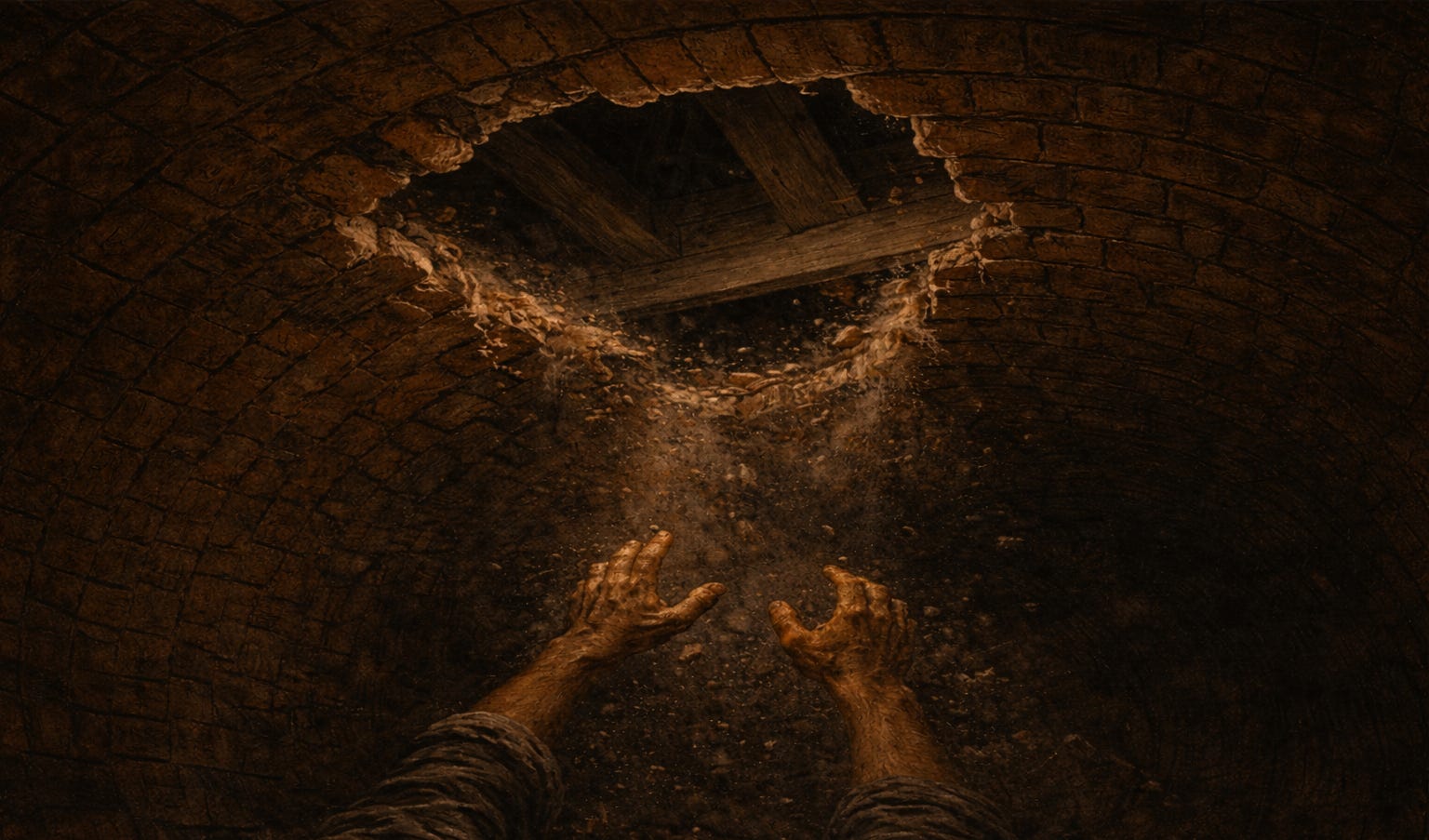
Old Man Anderson, serving a life sentence, and Detroit Jim, who called himself the best burglar east of the Mississippi, lay side by side in the pitch-black dugout, six feet below the surface of the prison yard. It had taken them three months and twenty-one days to complete the dugout. Although there was always a guard somewhere along the north wall, the spot they had chosen was hidden from view by a small tool shed. Whenever they could dig—which was only now and then—a group of prisoners sat on the mound of dirt next to the shed. Luck had piled up this dirt from other official excavations in the yard, and the dirt from their tunnel blended perfectly with the rest.
No one could spot their work. If a guard came around from the mat shop or stepped out of the Principal Keeper’s office, the prisoners lounging on the dirt pile during their noon break or in the late afternoon after the shops had closed would silently mouth warnings to Jim and Anderson. That gave them plenty of time to slide a few boards over the opening, kick some dirt on top, and even wheel a barrow across the entrance—and just like that, they were safe.
That work now lay behind them. Dirt sifted down onto Old Man Anderson’s gray hair in the dark. But neither the darkness, the heat, nor the falling dirt registered. Something far more serious filled his thoughts. How soon would Slattery, the prison guard who now lay dead in the alley between the foundry and the tool shop, be discovered? For years Slattery had been a decent enough friend to Old Man Anderson, but what did that matter now, when his sudden appearance had made him, despite their friendship, an unexpected obstacle to his escape? He had turned into the alley just as Old Man Anderson and Detroit Jim were crouching for their final leap into the dugout. A blow—a dull thud—and that was all…
Anderson lay there, eyes wide open, staring into the pitch-black void of the hole. For the second time, he had killed a man, and God knew he hadn’t meant to, either time. Fourteen years earlier, a man had tried to steal his wife while he was serving a one-year sentence in the county jail. Both had carried guns, and Old Man Anderson had shot first, or he would have been shot himself. That hadn’t been murder—not really. And as for Slattery, big, heavy, slow-moving, red-faced Slattery, Anderson would normally have gone out of his way to do the guard a favor. But when it came down to Slattery or his chance at freedom—that was different.
For the second time, he had killed a man, and God knew he hadn’t meant to, either.
Old Man Anderson rubbed his right hand in the dirt and held it up before his eyes in the darkness. He knew the dampness on it was Slattery’s blood. The iron pipe in his hands had struck Slattery’s head only once, but once was enough.
Old Man Anderson broke into choking sobs. The younger prisoner jabbed him in the ribs and swore under his breath. Anderson stifled the sound but kept sniffling and trembling. This time there was no question: it would be the Electric Chair if they caught him. Within minutes, they were bound to find Slattery’s body. Anderson couldn’t turn himself in now, no matter how this tunnel or the supposed old sewer line turned out. At first, he had planned to crawl out and surrender if everything failed. But to come out now could mean only one thing: the Chair.
For all his fourteen years behind prison walls, the image of the Chair had haunted the old man. When he was first sent to prison, his cell had been in the death house, separated from the Chair by only a corridor, twenty feet long, they said, and taking no more than five seconds to cross. Until his cell was changed, that grim, dreadful Thing in the next room seemed to move closer every day, looming larger and broader in his mind, until it blocked out everything else in the world—closer, closer, until it was only seven unbelievable hours away. Then came the commutation of his sentence from death to life.
The next day, Old Man Anderson, gray-haired even then, left the death house to rejoin his fellow prisoners but went straight into the prison hospital, where he lay for three months, a victim of chair-shock as soldiers were of shellshock. And from that time on, his hands never completely stopped trembling.
Now he was a murderer for the second time. In the darkness, he reached out and felt a stack of tin cans beside him. Detroit Jim had been clever—very clever. Jim had worked in the storeroom, and for the past ten days, the wiry burglar had managed to sneak out at least one can from the prison commissary each day. They now had food enough to last maybe two weeks. They also had matches, candles, and even a temperamental little flashlight. No cigarettes or cigars—just chewing tobacco, since smoke could be smelled from far away when searching for escaped convicts. And there was even a can of water, half the size of a trash can.
Despair gripped Old Man Anderson, and a wave of nausea washed over him. All the food in the world couldn’t bring Slattery back. That Thing in the death house rose again before his mind’s eye. For years he had carried a private fear that some new governor might come along and restore his sentence to what it had been at first, and all his good behavior through those endless years would count for nothing. Until Detroit Jim had told him about the long-forgotten sewer tunnel, he had never once thought of breaking the prison rules.
The old man’s teeth chattered. Detroit Jim’s thin fingers tugged at his sleeve—a signal to get moving and start digging with the short-handled pick. Anderson crawled into the narrow tunnel, just wide enough for his body and arms to move. As he hacked at the damp earth, he pictured in his mind the grimy sheet of paper now tucked in Detroit Jim’s pocket, the one their lives depended on. It was a tracing made by a former prisoner from a dusty, leather-bound book in the New York Public Library, sent to Jim through the underground network. The book contained a report by some long-forgotten architect from the 1850s, and the diagram in it showed a working water and sewage conduit. It ran from the prison building straight across the yard, six feet below ground, then under the north wall, beneath the street, and out into the river. Built of brick, four feet wide and four feet high, it was a ready-made tunnel to freedom.
Old Man Anderson could hear Detroit Jim muttering as he hacked at the dirt, pushing it back beneath his stomach, where Jim’s hands grabbed it and pushed it farther behind them.
“We’re only a couple feet from that old conduit now,” Jim said. “Dig, you son of a bitch, dig. Cut the sniffling. You dig first, then I’ll dig. Save the matches and candles for when we truly need them.”
Mechanically, the old man kept hacking at the wall of earth before him. Every so often, the pick struck a stone or some other hard object. In recent days they had unearthed several bits of old brick. To the old man, each crumbling clod of dirt felt like one more step toward freedom. They also pushed thoughts of Slattery from his mind. So he kept digging, for how long he did not know.
Eventually, his pick hit something solid again. He struck it harder. It gave way a little. On the third blow, it seemed to sink back. A musty smell filled his nose. An empty space opened above him. The old conduit? He bit back a shout.
From somewhere—muffled at first, then growing sharp and piercing—came a long, rising wail that seemed to rise straight out of the ground itself. The sound swelled, faded, and swelled again. Old Man Anderson’s pick tore frantically at the dirt, then at whatever blocked their way. Detroit Jim flicked on the weak flashlight. It was a wall, the wall of the conduit.
The prison siren continued to split the air, screaming across the countryside the announcement of an escape.
They no longer knew what time it was—whether it was night or day, or even which day it might be. They had slept, of course, but had a week passed? Two? If two full weeks were gone, and if the prison officials behaved as expected, they would have stopped searching inside the walls by now.
Old Man Anderson and Detroit Jim huddled together in the blackness of the conduit. A hundred times they had crawled from one end of their vault-like prison to the other. In their desperate, useless search for a way out, they had burned through countless matches and several candles. And since Anderson needed light to fight off his panic attacks, the last candle had been used for that. Now they were swallowed by complete darkness.
The conduit was blocked. By packed earth at one end and a brick wall at the other. Along the twisting hundred feet of the tunnel, they had pried out brick after brick only to find solid dirt behind each one. Just a few cans of food were left, and the water was completely gone. The liquid from the cans only made their thirst worse.
Old Man Anderson had come to hate Detroit Jim. Every word Jim muttered, every movement he made, deepened that hatred. Anderson had convinced himself that Jim meant to abandon him the next time he fell asleep—maybe even kill him and leave him there in the dark. They had practically stopped speaking to each other. Anderson turned over and over in his mind a plan that gave him grim satisfaction. The next time Jim slept, he would crawl back through the hole in the conduit wall, pry up the boards covering the opening into the yard, wriggle out, and take his chances climbing the wall. Better to be shot by a guard than die like a rat in this foul hole, unable to stand and afraid to lie down because of the things forever crawling through it. His thoughts were shattered when his companion grabbed his arm.
The old man’s cry froze in his throat. Footsteps! Faint and far away, somewhere above them, briefly clearer, then fading—gone.
Detroit Jim yanked Anderson’s head close and whispered. “Sidewalk. People walking overhead. We’ve never sat right here before. We wouldn’t hear them unless they were walking on stone, or slate, or something solid.”
The old man’s heart pounded like a hammer in his chest. Detroit Jim grabbed the pick and started prying bricks from the arched ceiling of the conduit. They worked like madmen—digging, clawing, pulling, stacking the loose bricks quietly on the floor.
For a moment, Jim paused. “How far from our dugout do you think we are?”
“About a hundred feet, I guess. Why?”
Without answering, Detroit Jim went back to work, chipping away at the bricks. A hundred feet from where they’d started wouldn’t place them under the sidewalk. Then Anderson realized why: it was the twists of the conduit. It took a hundred winding feet to cover barely thirty in a straight line.
At last, Detroit Jim handed the pick to the old man. Feeling around in the darkness, Anderson found the gap—about as wide as his outstretched arms—where Jim had pried out the bricks. It was filled with soft earth, and Anderson began digging into it. As he worked, loosened dirt rained down on him: on his head, into his eyes, nose, and ears…
The old man’s pick struck stone overhead.
Detroit Jim jumped on the pile of bricks and pushed Anderson aside. “Feels about three feet long and two feet wide, probably slate.”
No light showed through the cracks.
Detroit Jim pulled out a large pocketknife and slid its blade along the stone. The blade hit something solid. Jim jerked it back. Still no light came through the crack.
“I smell fresh air,” he said, “but I can’t see a thing. Must be night. We have to lift this stone before anyone passes by. The hole’ll be large enough for us to climb through.”
“I smell fresh air,” he said, “but I can’t see a thing.”
Old Man Anderson’s heart leaped. It was over. They had made it. He’d see to it they never caught him for the Slattery affair.
As Detroit Jim worked at it, the stone began to give. Balancing on the unsteady pile of bricks, the two men pried and twisted until, with a final wrench, the stone came crashing down.
The noise from the falling stone seemed loud enough to wake the dead, but no sound came from above. Quickly, they lifted the slab and balanced it securely on the pile of bricks.
Detroit Jim climbed onto the makeshift platform. “I see no sky, no stars, and I feel no wind. There’s no trace of light, not even a faint glow.”
His knife dropped. The tinkle echoed dully down the conduit. He stooped to where Old Man Anderson stood, breathing hard. “It’s a—a room!”
“A—a room?”
Detroit Jim hauled himself through the opening, then leaned down, groping for the old man’s hands. “Come on. After me. Up! I’ll pull you up.”
Gasping and trembling, the two men finally stood together in a deeper darkness than before, clutching each other. Anderson strained to hear even the faintest sound.
“For God’s sake, don’t fall back into that hole,” Detroit Jim said. “Listen… We’ll crawl together until we hit a wall. Then you go one way and whisper what you find, and I’ll go the other. Look for a window or a door or anything that leads out. We’ll meet up again after that. You ready?”
“I—I’m scared.”
Detroit Jim’s fingers clamped onto the old man’s arm and dragged him forward. Anderson’s searching hands brushed against a wall, a wooden one.
“Found the wall.”
Detroit Jim straightened and pulled Anderson up beside him. The old man trembled. Gently, Jim pushed him to the left.
Anderson crept slowly, like a cat. His fingers touched a smooth, thin cord.
“I think I’ve found a rope…”
Jim called from the other end. “I’ve got a doorknob. Still don’t see any light. You find any windows? Furniture?”
“No. Just this rope… Wait, I feel another one.”
“See where those ropes lead. I’ll open this door.”
Anderson’s fingertips traced the rubbery strands. More emerged, bundling together.
“The door’s locked. Still see no light. Where do the ropes lead?”
“Seems like the room’s center.”
Anderson touched a metal band. Padding lined its inside. His shin struck something solid. He reached down. And screamed.
A sudden, terrible cry filled the air, followed by a gasp and a thud. Jim turned. What in God’s name had happened to the old man? That scream was loud enough to wake the whole world.
Detroit Jim stumbled across the room in the dark. The old man made no sound now.
Footsteps outside.
Jim dropped to his knees, hands out in front of him. A sharp click, then the whole world exploded in white, blinding, searing light. He threw one arm over his burning eyes.
A voice shouted. “Hands up.”
There was a rush of footsteps, a rough grip on his shoulders… A moment later, he blinked down at the terror-twisted face of Old Man Anderson—dirt-streaked, bearded, hollow-eyed—dead.
Slowly, his eyes lifted past the body on the floor. In front of him, its empty arms reaching toward him, its straps and wires coiling like snakes, stood the Chair.
Looking for More Stories?
Read Nikita’s fiction here.
Or catch up on these stories from Curated by Costiuc:


Personal Updates
Where You’ll Find Nikita
📝 “Drop In and Write” Writing Group
Giving feedback, sharing my own work, and participating in great conversations
Every Thursday, 5:30–7:00 PM
Free admission
🍽️ Feast Kitchen – Volunteering
Helping immigrant chefs serve delicious food
• Saturday, February 7th, 3:30–7:30 PM
• Saturday, February 14th, 10:30 AM–2:00 PM
Menu items range from $15–$25
This Month’s Snapshot

Daria and I celebrated our anniversary with a trip to Leavenworth. Leavenworth has a Bavarian theme and is a great place for a weekend getaway.
Pupdate

Arya has a brand new jacket.
Next Month on Curated by Costiuc
Trapped in ice, Henry Hudson investigates a death aboard his ship, unaware that the real danger is the men he chooses to trust.
Curated by Costiuc is a monthly newsletter featuring curated mystery, thriller, and suspense stories. The original text of O. F. Lewis’s “The Getaway” is in the public domain. This adaptation, updated for modern readers, is copyrighted © 2026 by Nikita Costiuc.
Nice twist at the end, but I kind of saw it coming.